 Return to Review Dungeon
|
May, 25 2026 |
 |
Wasteland PUBLISHER: Electronic Arts DEVELOPER: Interplay RELEASE DATE: 1988 COMPLETION TIME: 36 hours RATING: A |

Wasteland is a post - apocalyptic RPG from 1988 and is set in the U.S during the 21st century. This is a party - based RPG where you can roll a party of up to four characters at the start, and have the choice to recruit up to three characters later on. The game world is relatively small compared to some other contemporary RPGs such as Ultima or Pool of Radiance, but is densely packed with a lot of unique locations that all feel worthwhile to explore. As you explore, you will engage in the turn-based combat system which while simple on the surface, has a surprising amount of depth with being able to move your party members individually within a top down and text based system. Wasteland later got a release on Steam and GOG called Wasteland - The Original Classic. This version is essentially the same game that was released in 1988. There are a few additions such as updated character portraits, a graphics smoothing option, a killer soundtrack that was created by a fan and added in because it was that good, and the ability to read the paragraphs from the manual in game (which are also narrated). All of these additions aside from the in-game paragraphs, are optional and I opted to disable them all except for the music. So while this isn't the original game, it's as close as you can get from digital stores and is honestly the best way to play the game today.
Character Creation and Skills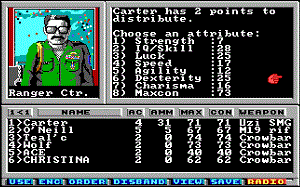
When you begin the game, you start at the ranger HQ. Here you have the option to create new characters for your party or stick with the default starting party. It is recommended to delete these characters and create your own party from scratch as you will have a better understanding of each of their strengths, weaknesses, and skills. When creating a character, the first thing is to name them, pick Male or Female, and their nationality. None of these options matter and are just there for personal preference. Next you must roll your starting attribute points. There are 7 attributes and each time you roll, the scores for each are random. Depending on the character build you generally want to focus on at least 3 attributes, the most important one being IQ. The IQ attribute determines your total skill points which are used to buy and increase skills. Also your total IQ is the deciding factor in how high a tier of skills you can learn. This is very important for all characters especially because the 2 best skills require an IQ of 21 and higher, being the doctor and energy weapons skills. At the end of the day, your starting attributes don't matter that much in your overall playthrough. By the middle of the game, your characters will be high enough level that you should have multiple attributes with over 20 points in each. So you don't need to stress too hard about getting the perfect roll. Next you can allocate your skill points for your starting skills. This game has a lot of skills so it is unclear what is actually important throughout your playthrough. Many skills only have 1 or 2 uses and most are not necessary for beating the game. The manual does explain each skill, but it's still unclear on what you need. For example there are multiple different firearm skills. You have clip pistol, smg, rifle, assault rifle, and AT weapons. You don't really know at first which type of weapon is going to be the most effective or common throughout the game. When I started, I just put a skill point into each one for my ranged characters because I wasn't sure what to focus on and wanted to try them all. This ended up being a waste of skill points because you're only going to use about 2 weapon skills anyway. It's best to not pick up too many skills at the start and save some of your skill points because later when you find a library, you can spend your skill points there too. By then you will have a better idea on what skills are actually useful.
Venturing ForthOnce you leave the ranger HQ, you're free to explore anywhere you want. The game is technically non-linear, however you will be punished for visiting certain areas if you're too weak. You start at the Southern end of the map and as you progress North, there are many locations to explore along the way. You're meant to visit each one and follow the breadcrumb trail of locations one at a time as you venture forth. This eases you into the game and keeps the difficulty balanced throughout for the most part. It's easy to get over adventurous and try to enter Needles or Vegas early on but you will find out very quickly if you're unprepared for these locations. Your main goal in Wasteland is only vaguely explained as: your rangers and your job is to help people. That's it essentially. So your objective as you visit each location is to talk to everyone and explore around thoroughly for anything to fix, kill, or loot. Pretty par for the course for most RPGs. Of course you don't have to help people, nothing's stopping you from just killing anyone in your way. You can still beat the game this way as well if you chose so. Eventually, late in the game, the overall goal to beat the game will become clear. Until then, you're kind of just going around following any leads that you can and exploring hoping it will get you somewhere or explain what's going on in the wasteland.
Combat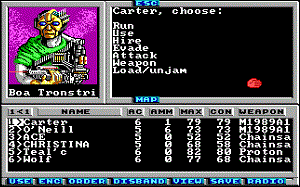
As you're exploring around the wasteland, you'll run into many random encounters with various enemy types. Most of these random encounters will consist of basic mutant animals, gunmen, thugs, ghouls, and eventually robots. Thankfully, unlike other RPGs of this era, combat encounters can be sped up to go by very quickly so you won't ever feel fatigued by constant slow enemy encounters. The combat system works very similar to Bard's Tale, it's a turn-based system and every round you give each of your characters commands and then initiate the round when you're done. Each character's turn will play out and display in text and the text crawl can be sped up or slowed down anytime at your convenience. This is a very nice feature that more turn-based games should have, especially those with lots of random encounters. I didn't feel like Wasteland had that many random encounters either. It was pretty reasonable and most enemy encounters are scripted-one-time events. This was definitely nice compared to Pool of Radiance or Bard's Tale. During your turn, you don't have a whole lot of options. There is no magic in this world, so you can attack which involves either melee or shooting. When firing a weapon, depending on the type of gun you may have a burst or single fire mode. Burst can attack more than one enemy at once and cost 3 ammo per turn. There are no precision shots in this game, that feature wouldn't be invented until Fallout, and later in Wasteland 2. You also have the option to run which will let you move either your whole party, or split them up individually. You can also use skills during combat, such as medic or doctor to help a critically wounded character. While the combat may be limited compared to other RPGs, it manages to have enough complexity to be fun. Also it doesn't feel like it overstays its welcome, due to the sparing amount of random encounters.
Quests and NPCs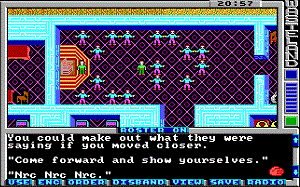
As you explore the different towns and locations, there are various activities and quests to complete. Most of these quests are optional and aren't clearly explained to you, you just have to explore and figure it out. For example, in the town Quartz, you can learn about a thug leader called Ugly. If you find his hideout, you can fight your way through and eventually fight Ugly himself, who also has a woman held hostage. Killing Ugly and saving the woman doesn't really earn you anything except some experience points and items, but it's fun to do and helps with your character progression. Finding these scripted encounters is important since scripted enemy encounters are the only enemies that actually drop loot. Random enemies don't drop anything and will only give you a small amount of experience. Fighting the scripted enemy encounters and collecting whatever loot they drop is the main way to getting better gear and making money. So while you could avoid raiding Ugly's hideout and the other main location in Quartz, you would be missing out on vital experience points and items.
As you explore and visit various buildings, you'll also find NPCs that you can talk to or even hire to add to your party. Talking to NPCs involves either typing in keywords or sometimes selecting a list of responses. When talking to some NPCs, it's not very clear on what keywords you can ask them, but usually it's optional anyway and just gives some extra info on the area. Talking with NPCs is pretty sparse and not a main component of the game like in Ultima IV.
Eventually near the end of the game, you will need to gather some specific keys that are necessary for navigating through the final two areas. The game is not clear on what keys you need, and there is no way to find out except just trying every key in your inventory until one works. Also I hope you don't drop any of these important keys because once you drop any item in Wasteland, it's gone forever. So if you acquire a secpass key or any key with a weird name like sonic key or pulsar key, keep it! Trust me you don't want to lose these important items. When you pick up important keys like these they just sit in your inventory like any other item and are not labeled specifically as a quest item or anything that could give you a clue, except for their name being rather unique.
Wasteland vs Fallout
Having played through both relatively recently, I have thoroughly enjoyed both playthroughs. As far as character builds, they are both about equal with the variety of characters to play as. Wasteland has the edge in being party based and letting you create four characters right at the start. In both games you can recruit party members, but in Fallout you are not given direct control over recruited companions. As far as skills, both games suffer the problem where a lot of skills are either rarely used or are completely unnecessary for completing the game. Fallout definitely condensed the skills down to a more reasonable level than Wasteland though, so it's easier to decide which skills to focus on. There is no more rolling for attributes in Fallout, you are given a set amount of points to allocate as you wish, which lessens the tedium of creating a character.
Combat in both games is pretty similar. Fallout is obviously not text - based and is able to immerse you more into the action in the world with its pre-rendered 3D graphics. Otherwise, systematically, the combat is mostly the same. Fallout has precision shots which let you target specific body parts. Of course Wasteland didn't have this feature, but it at least gave you full control of your party, unlike Fallout.
The story in each starts off very different, but the end goal is much the same. In Wasteland, you're just a band of nobody rangers with a vague goal to help people in the wasteland. In Fallout, you're the chosen one essentially and must get a water chip to save your vault. This does add urgency and motivation to the story, but I think the more blank slate approach of Wasteland fits better for an RPG.
Well, in the end, I think as an RPG, Wasteland is the superior game. As far as worldbuilding, story, and atmosphere however, Fallout definitely wins. So I guess it depends on what matters to you most in a game.
Wasteland vs Pool of RadianceEven though these games were released in the same year, Wasteland is a much more forgiving and easier game to get into in my opinion. This may seem a bit unfair since POR adapts AD&D tabletop rules which were not originally designed for a video game, while Wasteland's rules were designed specifically for this purpose. However, I think it's interesting to note the differences in design philosophy between the two.

One thing that's nice about Wasteland is cash doesn't have weight. You can carry around 10s of thousands of dollars and not even think about it. In POR, currency very much has weight and it's unwise to grab every bit of silver that an enemy drops. You won't need much money in POR since most of the best gear is found in the world, but you will have to keep some to pay for training to level up your characters and for other miscellaneous services.
Something that POR does exceptionally well is its tactical turn-based combat. Not only is it incredibly more complex than Wasteland, it's some of the finest turn-based combat ever designed in an RPG. This is a bit of an unfair comparison since Wasteland's roots come from Bard's Tale which predates POR and D&D RPGs. This style of combat is almost purely text based, although Wasteland has a few additions that make it more advanced. This being the combat encounters taking place within the game world and the ability to move individual party members around freely. This feature does not come close to the level of freedom and complexity POR provides, but it is an improvement from Bard's Tale. However, while POR has the superior combat system, it also is dragged down by an obsessive amount of random encounters and many of those random encounters having far too many enemies. POR does let you increase the game speed like in Wasteland, but still due to the nature of the combat system being more involved, getting through combat encounters takes longer and can be more tedious. This is where Wasteland has the advantage. The text based combat automates most things and allows you to get through combat encounters quicker. That added to the fact that there are far fewer random encounters than POR, makes Wasteland feel less grindy and keeps the pace from constant interruptions.
Now I could go over all of the little details about 1st edition AD&D that POR incorporates and compare them in depth with Wasteland, but I will spare you from that. Suffice it to say, Wasteland manages to be a surprisingly forgiving and playable game even today thanks to its RPG systems being designed for a video game first and with quality of life features in mind. While POR adapts the AD&D rules well and was the first CRPG to do so, it leads to some tedious gameplay and interactions.
Which game is better as an RPG? Well mechanically POR wins due to the nature of using such an intricate and advanced ruleset. As far as worldbuilding and interactivity, I think Wasteland has the edge here. POR does have the Forgotten Realms setting to work with, but it does lead to a rather generic fantasy world. It is cool and has interesting places to explore, but it's nothing you haven't seen before. Wasteland is an original setting, being post-apocalyptic America. There are also a lot of cool sci-fi elements with robots and Finster's mind maze. There are also more NPCs to interact with that you can actually have conversations with. In the end I think they are both excellent RPGs that scratch different itches depending on what you're looking for.
| Pros | Cons |
|---|---|
|
|

