 Return to Review Dungeon
|
April 29, 2026 |
 |
Ultima IV: Quest of The Avatar DEVELOPER: Origin Systems RELEASE DATE: 1985 COMPLETION TIME: 46 hours RATING: A |
 |
|

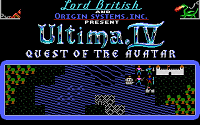
Ultima IV released in 1985 and was published by Origin Systems. It was originally released for computers such as Apple II, IBM-PC, and C-64. Later in 1988, Ultima IV would get a release for consoles. In this review, I will be discussing the 1985 IBM-PC DOS version. This version is generally considered the best and most complete version of the game. The other pc ports are lacking in graphical details. As for the console ports, the NES version differs greatly from the PC version. The Sega Master System version however, is nearly identical. This version has the benefit of being able to play with a controller, and dialogue options rather than typing in keywords like on the PC. The dungeons are also top down view, rather than first person. Other than those changes though, the games are identical. It is also worth mentioning that there is a mod called the upgrade patch which improves not only graphics, but adds music from the Apple II and Commodore versions, and fixes some bugs. For the sake of keeping the experience close to the original, I am not playing with this mod. It is definitely an impressive mod though, and probably is the best way to play the game these days along with the SMS version.
What is Ultima IV about; Ultima IV really pushed the boundaries for RPGs and games in general back in the day. Rather than just being about dungeon crawling and fighting monsters, Ultima IV is a journey of spiritual enlightenment. The goal of the game is to become the embodiment of the Avatar. In order to do that, you must represent and embody all eight virtues, descend into the Abyss, and read the Codex of Wisdom. You must set an example for all the people of the land by performing good deeds, meditating at shrines, acquiring magical runes, and forming a party of seven other adventurers who will lead by your example of being virtuous. The number of virtues isn't any random number or a coincidence. The number 8 is used across the whole game and is a strong theme throughout. There are 8 virtues, 8 stones, 8 runes, 8 towns, 8 weapons of each type, 8 classes, 8 dungeons, and so on. Each of these 8 virtues are then governed by 3 guiding principles: Truth, love, and courage. Understanding the virtues and the three principles is crucial to your success in becoming the Avatar.
The Start of The JourneyYou play as the stranger who was whisked away from their own world, to the world of Britannia. A gypsy woman in an old cart asks you questions, of which your answers to them will determine the path that you will walk on your way to becoming the Avatar. This essentially determines your class and starting attributes. Based on your class, you will spawn at one of the many cities of the land. I started as a ranger and began at Skara Brae. The most important thing to do when visiting a new town, is to talk to everyone. Every character responds to Name, Job, and Health. Asking these questions will sometimes lead to them telling you about something which you can then ask about which will further the conversation. It is important to talk to everyone because some characters will tell you important information on where to find runes, stones, shrines, mantra, quests, etc.
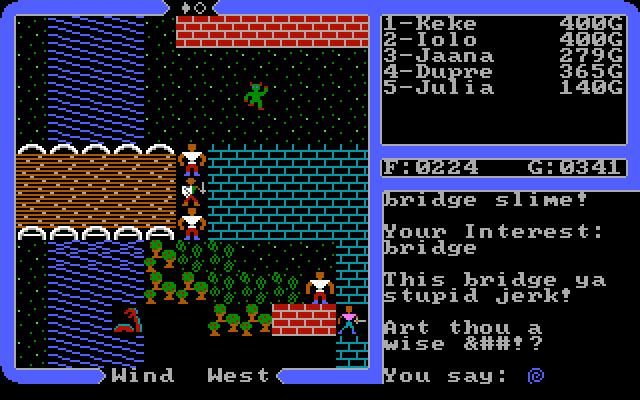
Each towne has a unique theme. The 8 major cities all represent each virtue. Then you have the smaller places that serve a purpose of their own. Buccaneer's Den, for example, is an isolated town located on a small island in the middle of the ocean. This province is a haven for pirates and outlaws. Here illegal and exotic goods are sold, of which can't be bought anywhere else. This town is also one of the only locations that contains a guild shop, which sells special items such as magic keys and a sextant. Each of these towns and places are important to visit and explore. As the game's manual suggests, you should visit everywhere and talk to everybody. One of the main ways you find clues on items, mantras, and other important stuff, is by talking to people.
Ultima IV is a non-linear game. You are only told a brief explanation on what to do and must figure the rest out on your own. It is also recommended that you read the manual and the book of history. The manual tells you all the important hot keys and explains the basics of the game's mechanics. The book of history explains not only the history and lore of Ultima, but also goes in depth of each facet of the game world. It really goes out of its way to describe each aspect of Ultima IV. Outside of these supplemental materials, you must learn things on your own with no hand holding. Of course, this is nothing new for a game of this era. Most contemporary RPGs from this time required players to figure things out on their own. Ultima IV really thrives from this however. The goal of the game is to achieve full Avatarhood and be completely virtuous. To reach this goal, you must understand the virtues and engage with the world completely. Thus, performing actions that would satisfy each virtue. If the game were to tell you exactly what actions you need to perform to earn favor in each virtue, then that would lessen the significance and impact of achieving Avatarhood. It would feel more like completing a checklist, than bettering yourself through your actions.
Progression and Role-PlayingThe progression system is rather simple. At the start of the game, you answer some moral questions from the gypsy woman. Your answers to these questions determine your starting class. Each class determines your starting attributes, preferred weapons and armor, and whether you can or can't cast spells. Once your class is determined, progression is as simple as earning experience by killing enemies and finding quest items. Then when you have enough experience, you can talk to Lord British and level up. Each new level will automatically increase your hitpoints by 100 and randomly increase each of your attributes. Same goes for your party members as well. One thing that kind of bothered me however, is experience from killing enemies is only earned by the character that delivers the killing blow. This can lead to the problem where you have high level characters that will get all of the kills and continue to level up, while your lower leveled characters will continue to not earn experience and stay behind. Another RPG that had a similar experience gain system was Wasteland and I am not a fan of it in that game either. This basically requires you to prioritize your low leveled characters to get kills while you don't attack with your higher leveled characters. It can be annoying and lead to your party leveling unevenly.
As far as the Role-playing Systems go, they don't require much thought compared to other RPGs. Ultima IV is more about your progression in Avatarhood and exploration, than about playing a number crunchy dungeon crawler. Not to say though that there isn't any dungeon crawling in Ultima IV. The combat experience however, is very simple as well.
CombatThe combat is turn-based and in a top-down perspective. When combat begins, you are able to control each party member one at a time. During a turn, you can only perform one action; move one space, perform one attack, or cast one spell (as long as the spell is prepared). The layout of the combat arenas changes depending on the terrain. Grass areas are just an open field, whereas rocky areas have cover and choke points. Within dungeons, combat arenas are more unique. Each combat encounter is designed relative to the location within the dungeon, depending if it's a hallway, corner, t-section, etc.
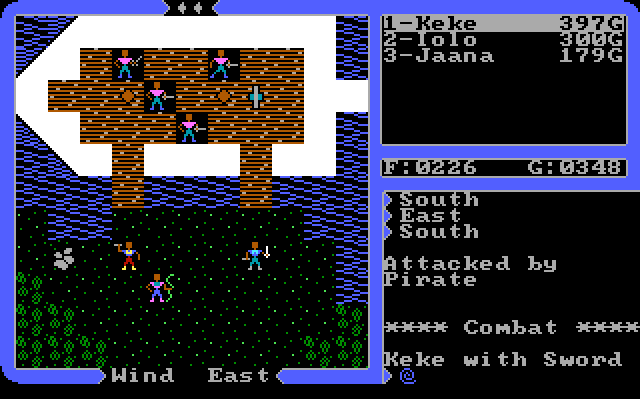
There is also ship boarding combat can be from land to ship or ship to ship. Ship to ship is usually an even fight, land to ship however gives a clear advantage to the ship since there is more cover and only two entrances. While sailing on your ship, you can also be attacked by sea creatures such as giant squids, seahorses, and sea serpents. These battles can be a bit tricky because these creatures have ranged attacks which can hit your party through the ship's hull. Your ranged characters and spellcasters can only attack enemies that are up, down, left, or right. They can't attack diagonally or through walls, while enemies can. In the Sega Master System version, your characters can attack diagonally at least. On the DOS version however, that is not possible unfortunately. This can lead to these ship battles at sea becoming rather tedious as you wait for the enemies to line themselves up with the ship entrances so you can hit them. Meanwhile they can attack any of your characters from any direction and through the ship itself. At the end of the day though, these fights and none of the combat encounters really, are that difficult anyway. So it just comes down to patience and time, rather than challenge. Which is another problem I have with combat, it's not challenging. Unless you start the game as a shepherd and have low attributes and no weapons, there is never really a challenge in the combat system. The only thing that will end up killing you or your party members is either poison, or getting blown up in your ship. So the random encounters in the overworld can end up feeling like a bit of a slog after a while. Luckily they don't take as long to get through as they do in Pool of Radiance or Secret of the Silver Blades, but they are still tedious. During dungeons, I find the combat encounters much more interesting however, since they play out more like puzzles and are mostly optional. Speaking of dungeons...
Dungeons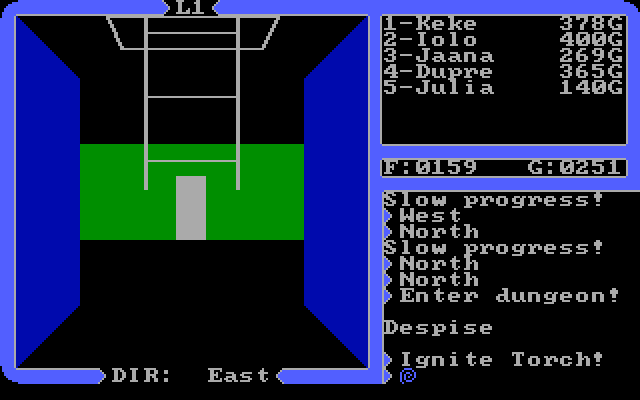 The dungeon design actually surprised me with how good it was. I would argue that while they may not be as intricate or as big as dungeons in Bards Tale or Pool of Radiance, they were much more enjoyable. Unlike those games, the dungeons are not the main event of Ultima IV and they don't outstay their welcome. When you enter a dungeon, assuming you have the dungeon map from the cluebook, you can expect about an hour or maybe even less of a venture. Each dungeon is 8 levels, of course, and each level is not very big. The goal of each dungeon is to find the altar and acquire the stone. There are also chests with gold along the way and magic orbs, which will permanently increase one or two of a character's attributes at the cost of some damage to their health. Those are optional and usually require going through additional challenges with enemy encounters and environmental hazards.
The dungeons really feel more like a puzzle than a gauntlet of non-stop combat encounters like in other RPGs of the era. The combat, aside from the random encounters which are few and far between, are mostly optional. When you enter a combat room, your goal is to get out of the room through one or more exits. The enemies are there, but you can ignore them if you wish and you won't get any penalties on your virtues unlike in combat encounters in the over-world. These combat encounter rooms don't just consist of combat however, there are also puzzles to solve with hidden doors and switches. In the dungeon of Despise, for example, you enter a symmetrical room with a pool in the north-center area. In the pool are sea monsters to kill. They are not that difficult to take care of, however that's not the real challenge. Once they are all dead, you need to find a way past the pool, which requires you to pay attention to the wall textures and find the hidden doors. Each hidden door opens another until you manage to open a walkway that appears over the pool into the northern room which contains the altar. This was a real stand out moment for me, with this dungeon being my first one. The rest of the dungeons continue this focus on paying attention to the environment and finding your way through until you acquire the stone.
The dungeon design actually surprised me with how good it was. I would argue that while they may not be as intricate or as big as dungeons in Bards Tale or Pool of Radiance, they were much more enjoyable. Unlike those games, the dungeons are not the main event of Ultima IV and they don't outstay their welcome. When you enter a dungeon, assuming you have the dungeon map from the cluebook, you can expect about an hour or maybe even less of a venture. Each dungeon is 8 levels, of course, and each level is not very big. The goal of each dungeon is to find the altar and acquire the stone. There are also chests with gold along the way and magic orbs, which will permanently increase one or two of a character's attributes at the cost of some damage to their health. Those are optional and usually require going through additional challenges with enemy encounters and environmental hazards.
The dungeons really feel more like a puzzle than a gauntlet of non-stop combat encounters like in other RPGs of the era. The combat, aside from the random encounters which are few and far between, are mostly optional. When you enter a combat room, your goal is to get out of the room through one or more exits. The enemies are there, but you can ignore them if you wish and you won't get any penalties on your virtues unlike in combat encounters in the over-world. These combat encounter rooms don't just consist of combat however, there are also puzzles to solve with hidden doors and switches. In the dungeon of Despise, for example, you enter a symmetrical room with a pool in the north-center area. In the pool are sea monsters to kill. They are not that difficult to take care of, however that's not the real challenge. Once they are all dead, you need to find a way past the pool, which requires you to pay attention to the wall textures and find the hidden doors. Each hidden door opens another until you manage to open a walkway that appears over the pool into the northern room which contains the altar. This was a real stand out moment for me, with this dungeon being my first one. The rest of the dungeons continue this focus on paying attention to the environment and finding your way through until you acquire the stone.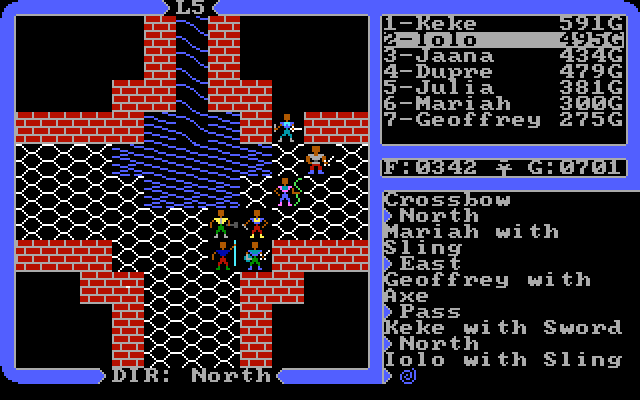
Ultima IV is also very generous to the player with escaping dungeons. You can create a spell called X-it which allows you to instantly leave a dungeon no matter where you are, as long as you're not in combat. There are also two spells called Z-down and Y-up which allows you to instantly go down or up a level in the dungeon. These spells combined can really trivialize the dungeon crawling if you use them liberally. I personally tried to avoid using the Z-down or Y-up spells unless I was really stuck, but the X-it spell? Man, I used that every time once I found out about it. It was a real life saver.
MagicThe magic system is quite unique and interesting. Spells cost reagents which are ingredients that are necessary to create each spell. The spell combinations can be found in the manual, which describes each spell and the required reagents to mix. This spell ingredient system adds an additional level of preparation to the combat and exploration. The only other magic system I can think of that compares is D&D. The D&D ruleset requires you to select which spells to memorize per spell level, and then rest to be able to cast them. Ultima IV allows for a bit more flexibility than D&D however. When a spell is mixed, any member of your party that has magic capability and enough mana, can cast the spell. So spells prepared are not on a character specific basis, like in D&D. It's also important to note the price of buying reagents depends on the town that you purchase them from. The prices of reagents, rations, and equipment, differ from town to town. For reagents, the best places to buy them are in Moonglow or Skara Brae. This makes sense, due to Moonglow being a mage specialized town and Skara Brae is home of the Rangers, who are magically attuned.
ConclusionIn the end, I had a great time with Ultima IV. While it's still combat heavy, the main challenge of the game comes from figuring out what to do, where to go, and completing puzzles. I enjoyed the more laid back and exploration focus of the game, as opposed to more combat heavy dungeon crawlers of the era. I enjoy a good dungeon crawler romp through Might & Magic, Pool of Radiance, and Icewind Dale, but it's nice to sometimes have an RPG that feels more like an adventure and a challenge of wits rather than tough combat.
I loved the variety of locations to explore and talking to each character to learn more about the world. Finding all the hidden runes and learning the mantras for the shrines is tricky and satisfying. The progression system is simple, which I don't mind since it requires less of a focus, because Ultima IV is more about the acquisition of knowledge, than min-maxing your characters. The combat is very simple as well, even the final dungeon in the abyss was more of a test of figuring out where to go and answering the questions, than overcoming tough fights. My party wasn't as high level as they could have been with 4 of them being level 6, 2 at 5, and one at level 1. Yet, I prevailed through the abyss without anyone except my level 1 character, Katrina, dying. Thankfully you don't have to keep all of your party members alive to beat the game. The spell system is also very well designed. Buying the reagents and mixing the spells properly to prepare spells added to the amount of preparation needed for spell casting. The spells can also be very overpowered as well, such as the resurrect or gate spell. These require special ingredients that can't be bought normally at the reagents shop and must be found somewhere hidden in Britannia.
Ultima IV is not a perfect game however, and there were quite a few annoyances that I ran into. I am not a fan of the design choice to make experience gain from kills, only granted to the individual that gets the killing blow. In a party based RPG where having a full party is required, this is one of the most annoying design decisions you can make. I don't know if anyone is actually a fan of this, but I find it adds an unnecessary extra amount of effort to leveling up your characters. In the case of Ultima IV, it is not that big of a deal, since as I previously mentioned, combat is very easy and you don't even need your party members to be close to max level to beat the game. I still find it annoying though because it leads to your party progressing unevenly. I much prefer when experience is distributed evenly among the party whenever it is gained. This does lead to larger parties leveling slower, but the result is not having to micromanage who gets experience or not. Moving on, I also found it lame that you can't attack diagonally in the DOS version, when this can be done apparently in the SMS version. Being able to attack diagonally would have been a big help, but it's not that big of a deal. There was also what I assume to be a glitch where some characters are unable to perform ranged attacks during combat while on or boarding a ship. I don't understand why this happens, but it was really irritating and made the battles become even more prolonged than they already were. I searched online to see if anyone else had this problem and could not find anything. Anyway, it didn't make the game unplayable but it was annoying. Lastly, It is unfortunate that the DOS version is lacking music. The soundtrack to Ultima IV is actually quite good and adds to the mood of the experience. Without it, you are really missing one of the best aspects of the game. I found a complete upload of the game's soundtrack on youtube and played that in the background during my playthrough. While not the same as it is in the game due to different tracks that are supposed to play at different times and the different ranges of sounds from the midi files, it still helped and made the experience more enjoyable.
Other than those minor issues, I really enjoyed my time with Ultima IV even if things do get a little grindy and tedious towards the end. If you want to buy the best magic weapons, prepare to grind a lot of gold, because they can cost anywhere from 1500 to 5000 gold. They really aren't necessary except for the abyss however, which requires magic or mystic weapons to be able to do damage, so I didn't bother acquiring them until the end. Still, I had a great time and would love to do a replay through the SMS version one of these days.
As for the previous three Ultimas, I skipped them because of a few reasons: One, because this is a long series with ten main games, four spin offs, and two handheld games. So I don't plan on playing every game in the series and wanted to start somewhere that was a good beginning point. And two, because the first three games, or four if you include Akalabeth, don't have much to do with the later games story wise so I wouldn't be missing out on much by skipping them. Now I have no doubt that the first three Ultimas are great games and normally I wouldn't skip to the middle of a series like this. However, there are so many more RPGs that I want to play and only so much time, so I am starting with Ultima IV. Some people online even suggest just playing Ultima VII, but I intend on delving deep into this series so I am not going to start with the 3rd to last game and skip all of the previous titles. I plan on playing every Ultima from IV up to IX including the Worlds of Ultima games and the Ultima Underworlds.
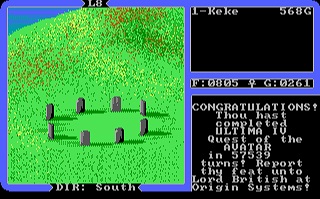
Avatarhood is a living gift. It must always and forever be nurtured to flourish.
For if thou dost stray from the paths of virtue, thy way may be lost forever.
 |
 |
|
| Pros | Cons |
|---|---|
|
|

