 Return to Review Dungeon
|
March 9, 2026 |
 |
Quest for Glory III: Wages of War DEVELOPER: Sierra On-Line RELEASE DATE: August 1992 COMPLETION TIME: 11 hours RATING: B+ |
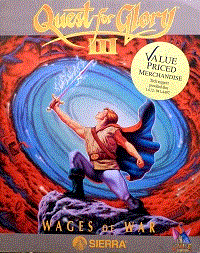
Quest for Glory 3 Wages of War, the next entry in the Quest for Glory series by Sierra On-Line. It's a, decent game, for sure. I will be honest, I don't have very strong opinions about this game. I wouldn't say that this game does anything exceptional over the last two entries. The graphics have definitely improved, and the dialogue and interactions are now all controlled by the mouse rather than the classic text parser which the genre was so well known for. This change especially may be controversial among classic adventure game fans. I personally prefer the text parser for these kinds of games, but the mouse based interaction works quite well here.
The story is decent but forgettable, dealing with a minor conflict that solves itself in a rather anti-climatic way. The final battle at the end is cool, but there is almost no build up leading to that moment and it ends rather quickly.
The RPG systems don't get much use in this game, with most of your skills and attributes being plenty high at the start if you imported from the last game. In addition, The gear and resources are also lacking in importance and variety. You have the only sword and shield you need given to you at the beginning. Consumables can all be easily bought and stockpiled in your huge inventory at the beginning, eliminating the need to restock again throughout the rest of the game.
Lets dive deeper into each aspect and see how well Quest for Glory 3 plays out compared to its previous entries. I will first discuss the story.
StoryThe story begins with the Prince of Shapier and Rakeesh receiving a magical message from Reeshka, Rakeeshe's life mate, that their homeland Tarna is in trouble. A war may break out soon and there is a demon that's been summoned in the land as well. The hero and Rakeesh must travel to Tarna through a magic portal and try their best to solve these matters. The two main tribes that exist outside the Liontuar city of Tarna are the Simbani and Leopardmen. There is tension between the two tribes which may result in war if nothing is done. The story mostly consists of the hero visiting the two main tribes and bringing peace between them. Then you must fight the demon at the end, which I had forgotten was even a part of the story after only an hour in because he's never mentioned or seen again past the intro. You are reminded of his existence near the end of the game and must infiltrate his fortress. Was the demon Ad Avis from the last game, or just some demon that was summoned by him? I am not quite sure as the game doesn't really make that clear. In the end, I wasn't too invested into the story with this one. It didn't quite have the grand stakes that the last two games had, and felt like more of a minor squabble that wouldn't affect much aside from the fate of two small tribes.
|
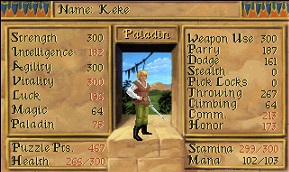
| The character sheet showing my end game stats |
The RPG mechanics felt like a pretty minor aspect this time around. Most of your skills are fairly high at this point and don't have much need for improvement. Especially if you imported your character over from the first game, which I did. The combat against enemies was a breeze once I got re-aniquated with the janky system. Climbing, at least as a fighter, was hardly ever used and didn't need to be trained. The only skills that were heavily used were throwing and agility. This is because about half way through the game, you must win a competition in the Simbani tribe in order to become a Simbani warrior and win the captured leopard woman as your wife. This competition requires you to win several trials including a spear throwing and tight rope balancing contest. As far as spells are concerned, since I was playing as a paladin, I was able to earn some paladin specific spells. These included flame sword, healing, firebolt, and some others. In order to earn those who had to gain enough honor points which, like the second game, have to be earned by making honorable actions. These spells make an already easy game, even easier. Being able to heal alone helps cut down the tedium of having to rest constantly or use pills to heal. I never had to use healing pills once in my playthrough.
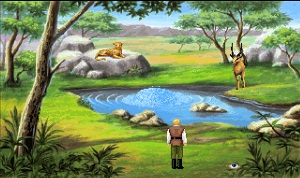
Gear and EquipmentThis leads me to the gear and equipment, which is rather lacking in this entry. As far as weapons and armor go, you are basically given everything you need from the start. You can buy weapons from the vendor, but they aren't needed. Whether they are any better than the starting sword I couldn't say, but either way they aren't needed. As I previously mentioned, combat is very easy from the start, and there is also the fact that you get the flaming sword pretty early on as well which is a constant effect spell you don't need to cast. There is also the matter of food and consumables. Again, with the healing spell granted as a paladin, healing items are not needed. Fatigue can be easily controlled by drinking water from the pool of peace. Hunger can also be managed by carrying a bunch of dried meat with you. So after buying a bunch of waterskins and a butt load of meat, you never need to worry about fatigue or food again. None of these stats mattered much in the last game too to be fair. Only the first game so far felt like managing my resources was an active part of the game. It seems though, that the resource management is being pushed to the side more with each entry.
CombatThe combat system is mostly unchanged from the previous entries. The camera positioning has once again been changed and looks similar to the VGA version of Quest for Glory 1. The combat mechanics themselves are the same. The glitchyness that occurs if you try to perform any actions too quickly is still there. This, however, can be overcome if you time your attacks at the end of each animation. The animations still get jittery, but it at least allows you to be able to hit the enemy.
|
| The Pool of Peace |
The graphics have seen a huge improvement from the last game. There is much more detail in the environments and UI. You can really see the generational leap here. There was something special about the older EGA graphics of the first two games that I miss, as well as the text parser though. But I can't deny the massive technical improvement here. Of course, if you already played the VGA version of Quest for Glory 1, then these graphics will look very familiar to you.
The text parser system has been replaced with listed topics to click on when in conversations. How you communicate now is by selecting the mouth icon and then clicking the character you want to talk to. Then a list of topics to ask will come up. Asking certain things will sometimes branch into additional topics related to the initial subject. You can also click on yourself to tell the character you're talking to, something specific or to greet them or say goodbye. This new system does make the game a little easier, since you no longer need to keep note of specific things to ask characters about. Conversations end up mostly guiding the player through them, without much thought required. There was a certain level of freedom and immersion in the old text parser system that you don't quite get when the dialogue choices are given to you, but I understand why they went this direction.
The music was also great in Quest for Glory 3. While it didn't blow me away, especially compared to the second entry, it had some really quality tracks in there that I greatly enjoyed. The tavern song and pool of peace were standouts for me. I also enjoyed the subtle atmospheric track that plays when walking around the streets of Tarna. I was also impressed when music of the different interiors would play when I got close to them while still outside. It was a nice little touch that adds to the immersion.
ConclusionOverall, Quest for Glory 3 felt more like a two parter in the middle of a season in a TV show. If Quest for Glory 1 and 2 were like 2 Star Trek movies, the 3rd game was a two part episode mid season of TNG. So it wasn't a bad game, but it wasn't as memorable or stand out in the series as the previous games. The story was alright, but I really just felt like I was along for the ride. There wasn't much sense of progression as most skills were already leveled enough at the beginning and there was hardly a challenge at all throughout the game.
| Pros | Cons |
|---|---|
|
|

